Scientists crack the bottleneck on a lifesaving cancer drug — boosting production 1,000-fold in yeast
There’s a cruel math problem at the heart of one of the world’s most important cancer drugs. Vinblastine, a chemotherapy staple used to treat Hodgkin’s lymphoma, testicular cancer, and breast cancer, is extracted exclusively from the leaves of the Madagascar periwinkle plant. It takes two metric tons of dried leaves to produce a single gram.
A team at Zhejiang University just rewrote that equation. Working with collaborators at the University of New Brunswick and Westlake University, researchers engineered brewer’s yeast to produce catharanthine — the direct chemical precursor to vinblastine — at 164.9 milligrams per liter of culture. That’s nearly a 1,000-fold improvement over any previously reported yield.
The results were accepted by Science and published online as a First Release on July 17.
The problem wasn’t that nobody had tried this before. In 2022, the same Zhejiang team — led by researcher Lian Jiachang from the College of Chemical and Biological Engineering — had successfully transplanted the entire 30-step vinblastine precursor synthesis pathway into Saccharomyces cerevisiae, the common yeast used in baking and brewing. But the yields stalled at micrograms per liter, far below anything commercially viable.
The bottleneck turned out to be a logistics problem inside the cell. The chemical intermediates needed to hop between different cellular compartments — the nucleus, the cytoplasm, the endoplasmic reticulum — and each transfer leaked yield. The team suspected that poor cross-compartment transport was the limiting factor.
Then a gene called CAD2 caught their attention. Earlier experiments had shown that when CAD2 was silenced through virus-mediated gene interference, vinblastine production dropped to just 10% of normal levels. That’s a massive signal that something important was happening.
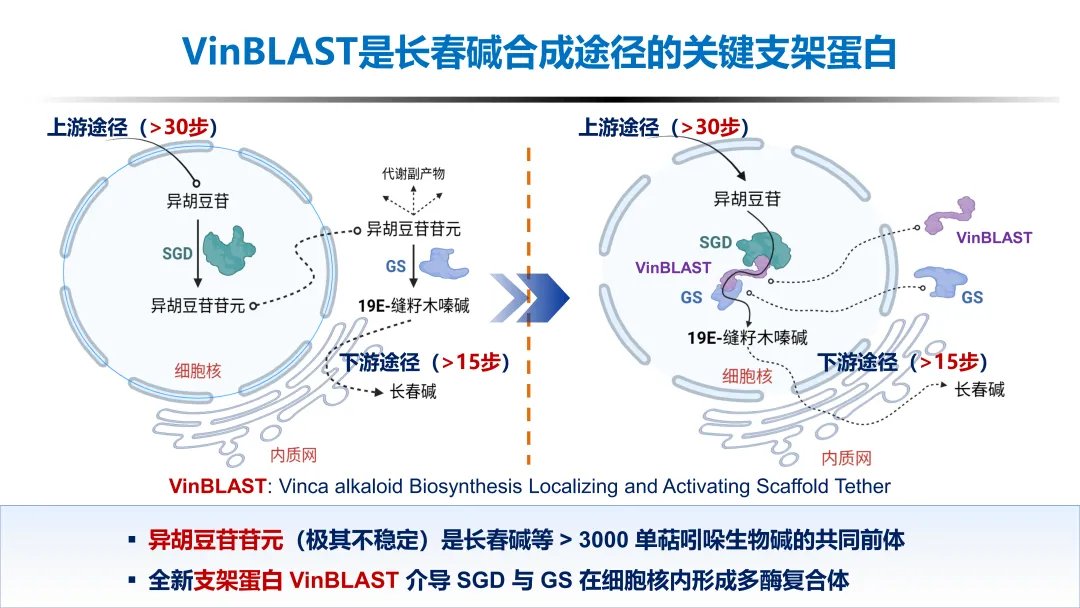
What the team found was a protein — which they named VinBLAST (vinblastine biosynthetic linking scaffold protein) — that acts as a physical bridge. One end of the protein grabs onto the SGD enzyme, the other end grabs onto the GS enzyme, pulling them together inside the cell nucleus to form a stable multienzyme complex. This eliminates the need for intermediates to travel across compartment boundaries, dramatically reducing losses.
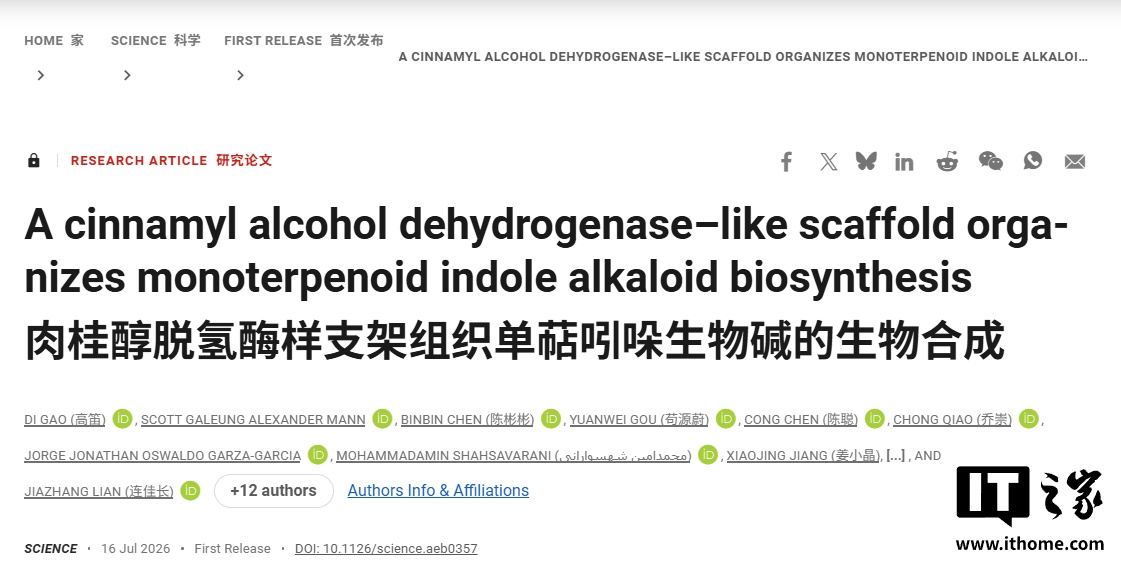
The combination of spatial reorganization and boosted enzyme activity pushed catharanthine yields to 164.9 mg/L. That’s still not工业化 (industrial-scale) production, but it crosses a critical threshold — from “interesting lab result” to “worth scaling up.” The team is already working with partners to push toward mass production of vinblastine and related alkaloids.
For patients waiting on chemotherapy, the math finally looks different.