Inside China's space station: Shenzhou-23 crew is running brain experiments 400 km above Earth
There is a quiet tension in the Shenzhou-23 crew’s daily routine that most Earth-bound workers never think about. For nearly two months, astronauts Zhu Yangzhu, Zhang Zhiyuan, and Li Jiaying have been living and working aboard China’s Tiangong space station — 400 kilometers above the planet — and while the public tends to focus on the grand imagery of docking maneuvers and spacewalks, the real work happening inside is far more mundane and far more consequential.
The crew is running what might be the most sophisticated battery of cognitive and physiological experiments ever attempted on the Chinese space station. In the biomedical research track, their in-orbit EEG testing program has been making steady progress. Using electroencephalogram采集 devices paired with VR headsets, the crew has been conducting a series of brain-computer interface experiments — testing weak-stimulus brain-computer interaction, microgravity intuitive physics perception, and spatial cooperative coding and regulation. Ground-based researchers are now analyzing the downlinked data to understand how the human brain adapts to long-term spaceflight.

But the brain is only part of the story. The immune system takes a hit in microgravity too, and the crew has been studying exactly how. They have collected saliva samples and environmental surface microbial swabs, which are now frozen and awaiting return to Earth. Back in the lab, researchers will analyze the glycoprotein glycoforms and microbiome composition in those samples, looking for correlations between immune changes and the prolonged space environment.
The astronauts have also been running motion analysis experiments with a structured-light 3D camera, capturing three-dimensional video of themselves performing specific tasks. The goal is to build a dataset of kinematic characteristics — how movement patterns shift over weeks and months in orbit — data that engineers will use to refine ergonomic designs for future missions.
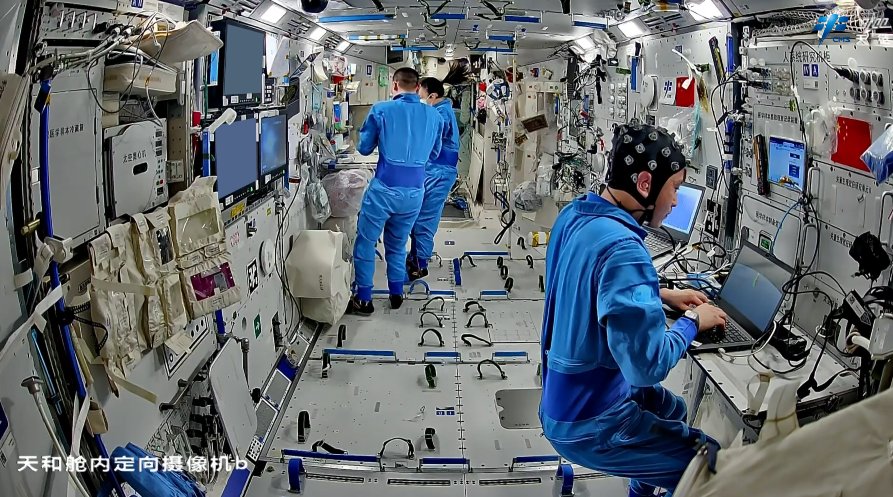
One of the more surprising experiments involves a simple physical test: the crew members alternately touch their nose and a blue handrail with their right index finger, a proprioceptive mechanical force perception test that measures how the brain tracks body position without visual input. The data feeds into the station’s broader research on how microgravity distorts the body’s internal sense of itself.
There is a psychological dimension too. The crew has been running emergency decision-making assessments and in-orbit emotional state tests, tracking how isolation, confinement, and the stress of spaceflight affect cognition over time.
On the station maintenance side, the crew replaced experimental samples in the fluid physics experiment cabinet and the online maintenance and assembly operation cabinet. Last week they also performed routine checks on the regenerative life support system, swapping out components and measuring cabin airflow, temperature, and air cleanliness. They even took microbial samples from the drinking water dispenser outlet — the kind of housekeeping that sounds trivial until you remember that a clogged filter or a mold bloom 400 km from the nearest hardware store is a genuine emergency.
To combat bone density loss — one of the most persistent physiological threats of long-duration spaceflight — the three astronauts have been sticking to a daily exercise regimen, using specialized equipment designed to counteract the skeletal degradation that microgravity accelerates.
The Shenzhou-23 mission is still in its early months, but the science coming down from Tiangong is already dense. What happens to the human brain, immune system, and body when we leave the planet for months at a time is not an abstract question anymore. It is being measured, sampled, and analyzed in real time.