Tesla's FSD Is Learning Your Driving Habits — and That Changes Everything
FSD has always driven the same way for everyone. That’s about to change.
Elon Musk confirmed this week that Tesla’s Full Self-Driving software is making a fundamental shift — from a generic, one-size-fits-all driving system to one that learns each owner’s personal habits. Instead of applying the same driving logic across the entire fleet, the neural network behind FSD will soon remember how you drive and adjust accordingly.
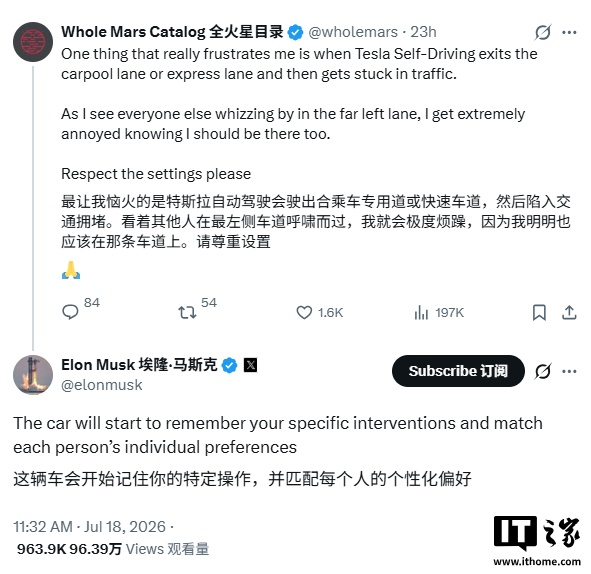
The announcement came in response to a long-standing complaint from a Tesla owner on X. User @wholemars described a frustratingly common scenario: FSD keeps pulling out of the HOV lane — the faster, high-occupancy lane — and merging into congested traffic, even when the carpool lane ahead is flowing freely.
Musk’s reply was direct: “Vehicles will begin to remember your specific manual interventions and adjust based on each person’s individual preferences.”
This is bigger than it sounds. Human drivers don’t all make the same call at the same intersection. Some drivers prefer the left lane, even if it’s moving at the same speed. Others stick to the middle lane to avoid merge points. Some people back into parking spots; others pull in head-first. FSD has historically learned a single unified driving policy, which inevitably clashed with individual preferences in edge cases.
Parking is the most obvious example. Different drivers have completely different parking habits — some always reverse in, others drive in front-first. FSD currently picks one approach. Once the system learns multiple parking modes, it can observe which style the driver uses and match the closest model. Musk previously hinted that FSD would learn where you like to park at home, the office, and your kid’s school. This latest confirmation makes clear that the personalization goes far beyond parking.
Tesla already offers HOV lane settings — Auto, Yes, and No — accessible through the navigation controls or via voice commands. Auto uses the interior camera to check if there are enough passengers for HOV access. But the setting is static. A system that learns from behavior wouldn’t need a manual toggle; it would just watch what you do and adapt.
The timing makes sense. Tesla recently shipped a somewhat intrusive takeover feedback menu that pops up every time a driver disengages FSD, asking why they took over. That data is feeding directly into the prioritization pipeline — telling Tesla which behaviors frustrate owners most. Parking disengagements are already the single biggest category of manual takeovers, which is likely why parking personalization is coming first.
The next major consumer release, FSD v15, is expected late this year or early next year, with roughly 10x the model parameters of the current version. That kind of scale jump would give the neural network the capacity to handle not just one driving policy, but many — personalized per driver, per vehicle, even per location.
A system that learns your habits doesn’t just drive better. It drives the way you would drive. And that’s the difference between an autonomous car you tolerate and one you actually trust.