Astronomers may have found the Milky Way's missing-link black hole
There’s a hole in our understanding of black holes. Astrophysicists know that stellar-mass black holes form when stars collapse, and they know that supermassive black holes — the kind that sit at the center of nearly every galaxy — can grow to billions of solar masses. How you get from one to the other has always been an open question.
An international team led by Dr. Zheng Xiaochen from the Beijing Planetarium may have found the answer hiding near the largest black hole we already know about.
The team’s study, published June 29 in The Astrophysical Journal, presents strong dynamical evidence for an intermediate-mass black hole (IMBH) lurking near Sagittarius A*, the supermassive black hole at the center of the Milky Way. Using large-scale N-body simulations on Tsinghua University’s high-performance computing cluster, they showed that an object with roughly 10,000 solar masses could explain a stellar puzzle that had astronomers scratching their heads for years.
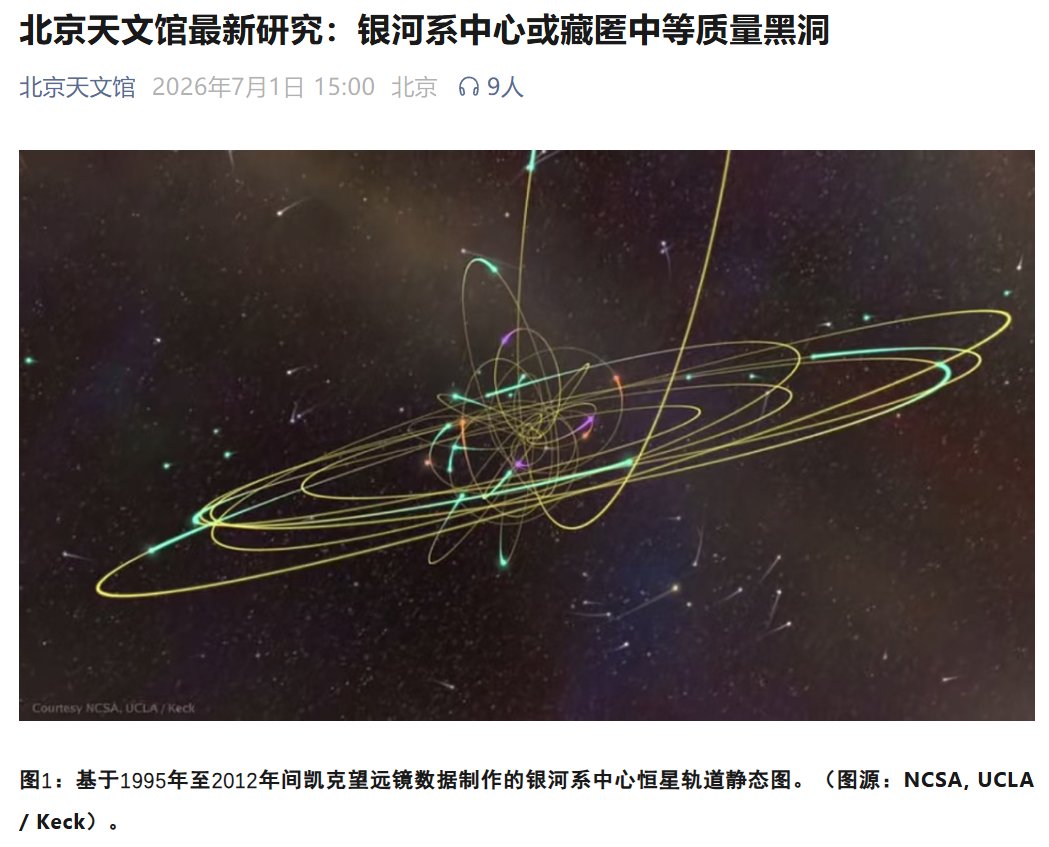
The puzzle centers on three groups of young stars near the galactic center. All three groups are about the same age — between 6 million and 15 million years old. Their orbits, however, look nothing alike. Some trace a thin, orderly disk. Others fly in wildly eccentric, randomly oriented paths. A third group sits somewhere in between.
By conventional stellar dynamics, that shouldn’t happen. Gravitational interactions that reshape orbits take billions of years, not millions. Something must have stirred things up.
The team’s simulations suggest that “something” is an intermediate-mass black hole, likely embedded inside a dense star cluster called IRS 13. The simulations recreated the observed orbital patterns only when a ~10,000 solar-mass object was included, exerting a slow, persistent gravitational pull on the surrounding stars.
The paper lays out a three-act dynamical process. First, the inclined gravitational source triggers the von Zeipel-Lidov-Kozai effect — essentially a long-range gravitational torque that flings outer stars into highly eccentric, tilted orbits. As the original gas disk dissipates, a sweeping secular resonance mechanism shapes the orderly disk stars. Finally, high-eccentricity stars kicked inward by these processes collide gravitationally inside the S-cluster, scrambling their orbits in just a few million years.
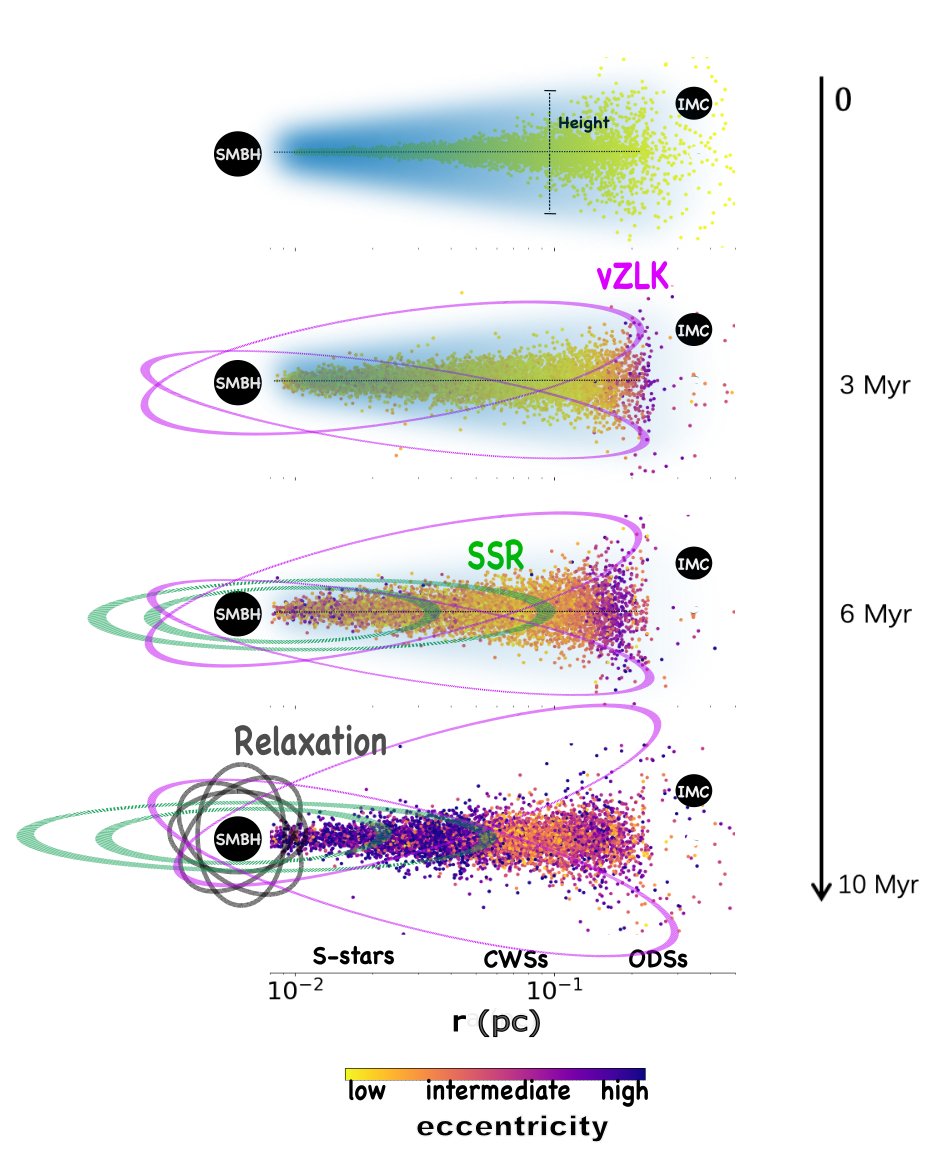
Intermediate-mass black holes — objects between 100 and 100,000 solar masses — are the missing link in black hole evolution. Astronomers have found only a handful of IMBH candidates, and all remain contested. Stellar-mass black holes form when large stars collapse. Supermassive black holes somehow grow to millions or billions of solar masses. The IMBH is the bridge between them, the stage of growth that theory predicts but observations have struggled to confirm.
If confirmed, this candidate near the galactic center would be a strong piece of evidence that IMBHs actually exist — and that they shape the environments around supermassive black holes.
The study also makes a testable prediction: the orbital precession of stars in the S-cluster should contain an extra component caused by the IMBH’s gravity, beyond what general relativity alone would produce. Follow-up observations by the upcoming China Space Station Telescope (CSST) and other high-precision instruments could verify this signal within a few years.

For now, the evidence is computational but consistent across multiple independent lines of reasoning. The missing link in black hole evolution may have been hiding a few light-years from the galaxy’s best-known black hole all along.