Scientists Just Caught Immune Cells Talking Like Neurons — And It Could Change How We Treat Inflammation
Your immune cells speak the same chemical language as your brain. A team of researchers in Germany has captured the conversation in real time — and it’s the first direct proof that human immune cells use dopamine and adrenaline to signal each other, just like neurons do.
Neutrophils are the most abundant white blood cells in the body — the first responders to infection or injury. Scientists at the University of Münster and Ruhr University Bochum discovered these cells have the same molecular machinery as nerve cells: they take up catecholamines (dopamine and adrenaline), store them in tiny vesicles, and release them directionally when inflammation triggers the alarm.
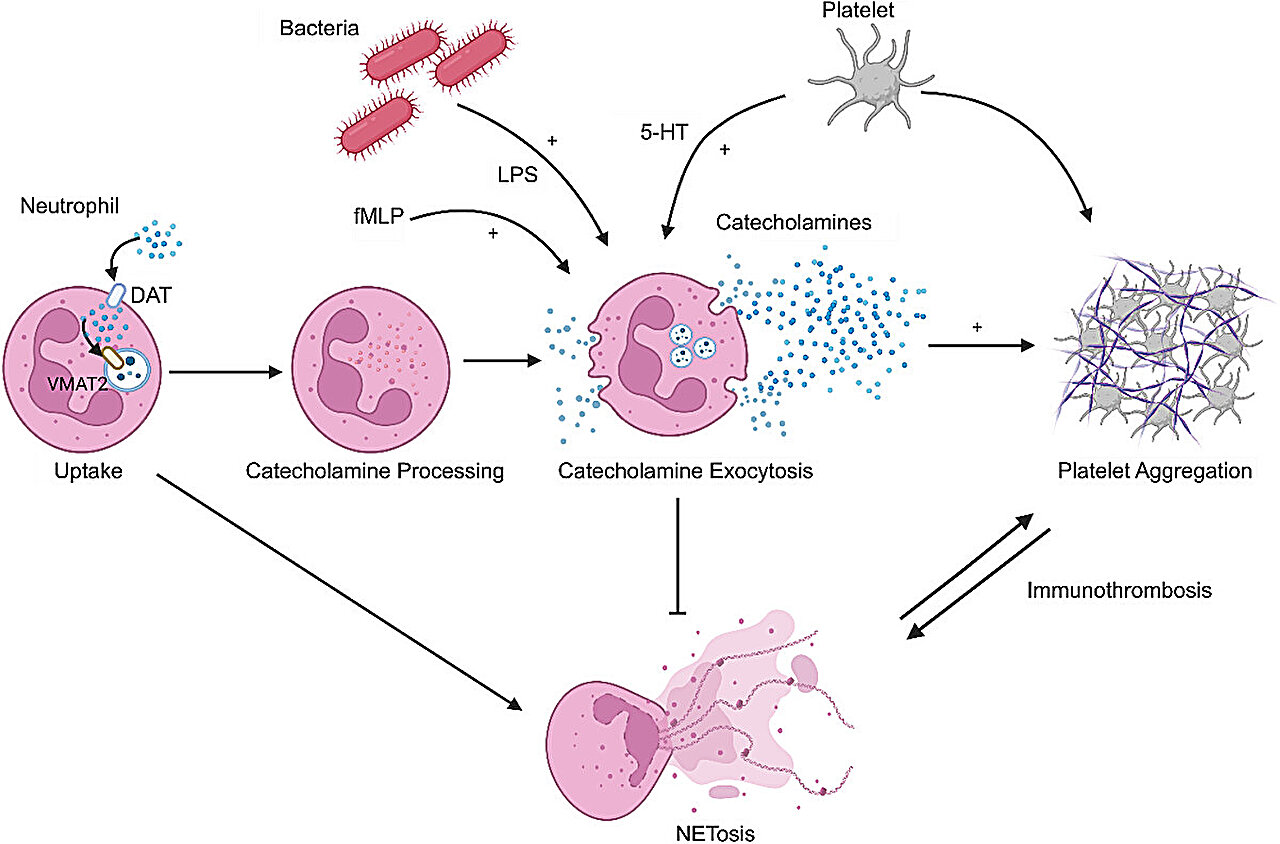
The key breakthrough was a tool, not just an observation. The team built fluorescent carbon nanotube sensors sensitive enough to detect catecholamine release from a single living cell under a microscope. “It fundamentally changes how we think about these cells,” said Sebastian Kruss from Ruhr University Bochum. “We simply lacked a way to visualize this process in live immune cells before.”
When released, the catecholamines do two things: they dial back the neutrophils’ own defensive response, preventing overreaction that can damage healthy tissue, and they promote blood clotting — linking the immune system directly to the vascular system in a way textbooks hadn’t captured.
To confirm this wasn’t just a lab artifact, the team induced mild inflammation in healthy volunteers and measured gene activity. The same mechanism was active in real human tissue. The neutrophils were adjusting their catecholamine receptors and synthesis programs in real time, responding to the inflammatory environment around them.
“We were surprised to see just how similar neutrophils and neurons are in their ability to process neurotransmitters,” said Louise Erpenbeck from the University of Münster.
Published in Advanced Science, the finding reveals a previously unknown commonality between two systems that researchers had assumed operated independently. More practically, it opens a new route for developing drugs that target inflammatory diseases — conditions from arthritis to asthma where the immune system’s volume knob seems stuck at 11. If scientists can learn to control this neurotransmitter-based signaling in immune cells, they may be able to calm inflammation at its source rather than just treating its symptoms.
The paper is available at: https://doi.org/10.1002/advs.202524193