Scientists observed the 'space-time limit' of an electron's motion for the first time
There’s a quiet tension built into the fabric of quantum mechanics. Heisenberg’s uncertainty principle says you can’t simultaneously know a particle’s position and momentum with perfect precision. But position and time? That relationship was never spelled out the same way.
A team of German researchers just closed that gap. Using attosecond laser pulses and a scanning tunneling microscope, they observed something they’re calling the “space-time limit” of an electron: a fundamental trade-off where better timing precision comes at the cost of spatial localization. The work was published July 3 in Nature Photonics.
The experiments happened at the Regensburg Center for Ultrafast Nanoscopy (RUN) at the University of Regensburg, in collaboration with the Max Planck Institute for the Structure and Dynamics of Matter in Hamburg. The team included physicists Jascha Repp, Rupert Huber, Franz Giessibl, and Klaus Richter from RUN, along with Angel Rubio’s group in Hamburg. Simon Maier is the first author.
Electrons move at extraordinary speed. On the attosecond timescale, which is one quintillionth of a second, an electron can cross atomic-scale distances while the atoms themselves barely budge. Ordinary microscopes give you a sharp static image but can’t capture that kind of motion. The team needed what amounts to an ultrafast camera for quantum particles.
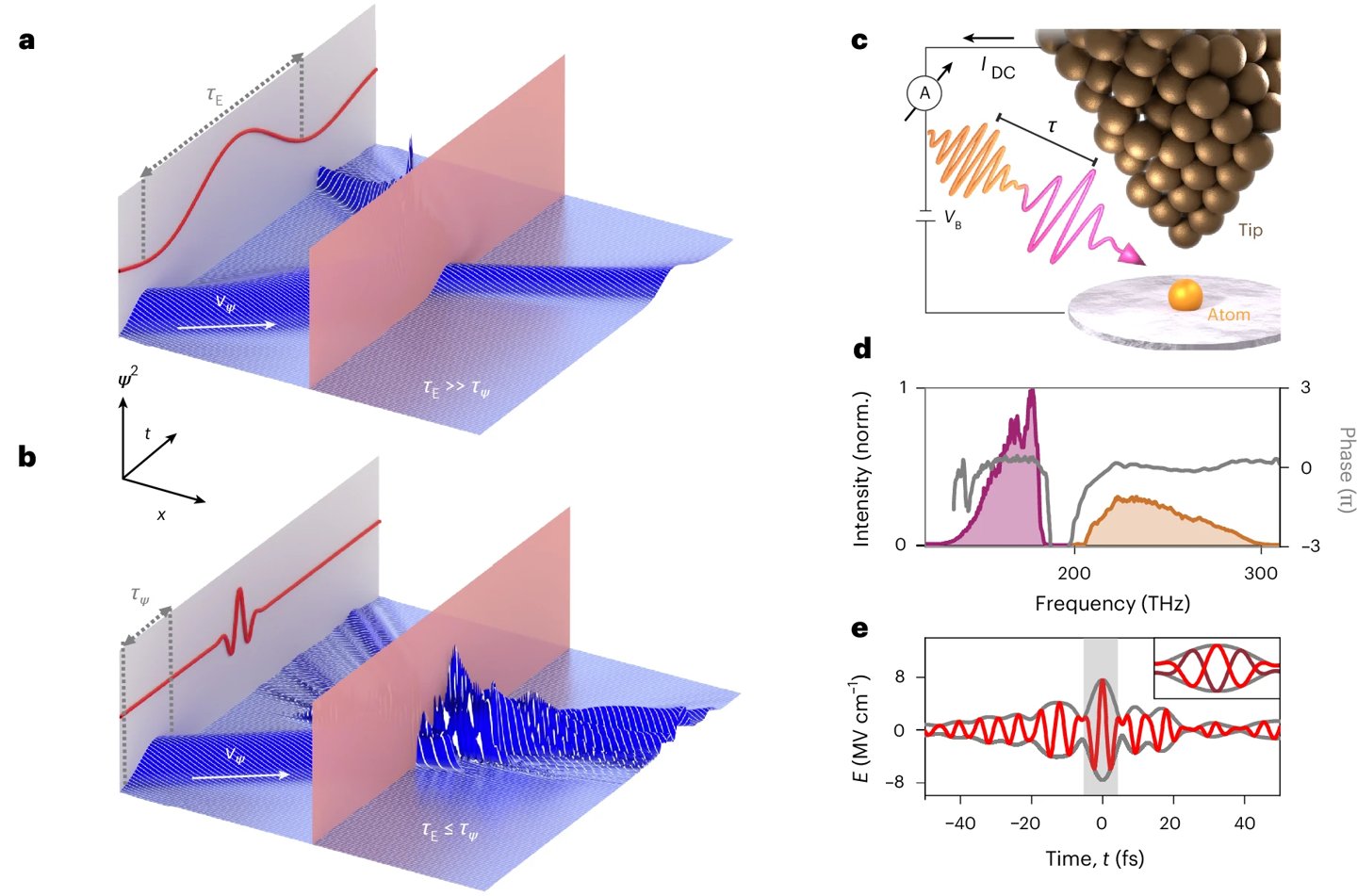
They built a lightwave-driven scanning tunneling microscope that uses precisely synchronized laser pulses to control and measure electron tunneling between a metal tip and a silver surface. Two near-infrared laser pulses, separated by a controlled time delay, altered the electron’s state. By measuring the resulting current, the researchers could reconstruct exactly when the tunneling event happened.
What they found: the electron doesn’t respond instantly to the laser field. There’s a delay of about 500 attoseconds. Quantum simulations from the Hamburg team matched the experimental data, confirming the timing signature was real.
Then came the trade-off. To pin down the electron’s timing more precisely, the researchers had to feed more energy into the system. That extra energy caused the electron’s quantum wave packet to spread out in space. Better time resolution came at the cost of spatial localization, which is what they call the space-time limit.
To measure this directly, the team placed individual copper atoms on the silver surface. Each copper atom acted as a tiny spatial constraint, helping localize the electron wave packet before the laser pulse hit. Even under strong laser excitation, the wave packet stayed tight enough to image single copper atoms at attosecond temporal resolution combined with atomic-scale spatial resolution.
This is basic quantum dynamics research, but it maps practical territory. Single-electron transfer represents the smallest possible charge movement. Understanding how to control it at extreme time and space scales could help researchers figure out how to trigger chemical bond formation or breakage with precision. The work also defines the fundamental speed limits of future electronic devices. As Rupert Huber put it, this kind of research sets a foundation for electronics and quantum information processing that operate at the intrinsic speed limit of electron motion itself.
The paper is available at DOI: 10.1038/s41566-026-01932-0.